


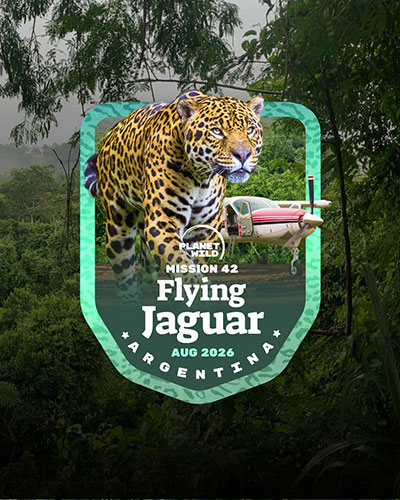
Across Argentina, jaguars are fighting for their future. Only an estimated 200 to 250 remain in the country, scattered across small, isolated populations. When these groups become separated, jaguars have fewer opportunities to find mates from other populations. Over time, this isolation can reduce genetic diversity, increase the risks associated with inbreeding, and leave already vulnerable populations more susceptible to disease and extinction.
Sometimes, helping a species survive means giving individual animals the chance to bring these disconnected populations closer together.
Meet Mimbi, a 20-month-old female jaguar born in the wild wetlands of Iberá National Park. Her next journey is unlike anything most wild jaguars will ever experience. She is being transported by plane to El Impenetrable, where introducing new genetic diversity could help strengthen the region’s fragile jaguar population.
It’s an extraordinary undertaking, but one with a much bigger purpose: helping ensure that Argentina’s jaguars have a future beyond the boundaries of their remaining territories.
The Mission: Reconnecting Isolated Jaguar Populations
Moving a wild jaguar across a country might sound extreme, but carefully planned wildlife translocations can play an important role in conservation. When populations become isolated, moving an animal to a suitable location can introduce new genetic diversity and create opportunities for a population to become stronger over generations.
For Mimbi’s journey, we’re supporting Rewilding Argentina, the organisation leading this ambitious jaguar conservation effort.
Its work in Iberá has already achieved a remarkable milestone. Jaguars had disappeared from the region before the first female was released there in 2021, marking the return of a free-roaming female after more than 70 years. Since then, more than 50 wild jaguars have been recorded in Iberá, offering encouraging evidence of what sustained conservation efforts can achieve.
Now, the focus extends beyond rebuilding a population in one location. Strengthening the jaguars of El Impenetrable is another important piece of the puzzle.
Transporting Mimbi requires careful planning and coordination. According to the project team, sedation presents particular risks for a jaguar of her size, so the operation is designed to avoid it. Minimising stress and ensuring her safe arrival are critical, leaving the team with a window of fewer than 15 hours to complete the journey and get her settled into her new home.
Thanks to the Planet Wild community, we’ve helped fund Mimbi’s relocation, staff salaries in both Iberá and El Impenetrable, and GPS collars that allow researchers to monitor released jaguars and learn more about their movements.
The support also extends to the people who share the landscape with these powerful predators. Working with local communities to protect livestock and build acceptance of jaguars is essential to making conservation successful over the long term. As jaguar numbers recover, finding ways for people and wildlife to coexist becomes increasingly important.
Ultimately, Mimbi’s journey is part of a much larger vision: establishing safe connections between isolated jaguar populations through a continuous corridor of suitable habitat along the waterways of the region. Rather than relying on future translocations alone, the goal is to give jaguars the freedom to move between territories, find mates, and exchange genes naturally.
One young jaguar cannot solve every challenge facing her species. But her journey could help lay the groundwork for a more connected future, where isolated populations have a better chance of thriving.
Sometimes, conservation means protecting an animal where it lives. And sometimes, it means helping it reach somewhere it can make a difference.
Planet Wild Total invested: €120,000
Immediate impact:
- Mimbi safely relocated to El Impenetrable
- Improved jaguar monitoring and coexistence measures
Ideal outcome:
- Greater genetic diversity and a growing jaguar population
- Local communities living safely alongside jaguars
- Connected jaguar populations across South America
Update Videos:
Impact Update Year One
Scheduled for 2027