


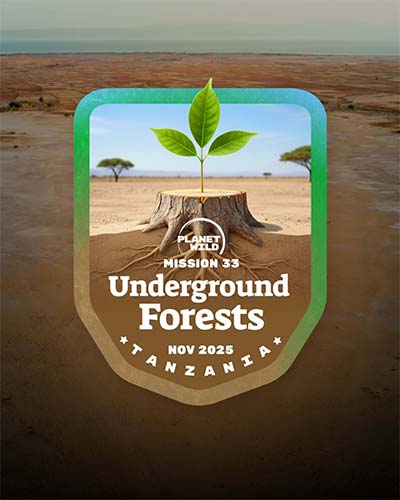
What if the key to restoring a forest wasn't planting new trees, but helping the ones already there come back to life?
Across Africa, deforestation and expanding desertification are transforming once tree-covered landscapes into dry, degraded land.
In places like Dodoma, Tanzania, conventional tree-planting projects often struggle to survive the harsh conditions.
But beneath the soil, an extraordinary opportunity remains: countless living root systems waiting for the right care to grow again.
The Mission: Bringing Underground Forests Back to Life
For generations, farmers across parts of Africa used traditional land-management practices to encourage trees to regenerate naturally. Many of these methods were disrupted during colonial rule, when traditional approaches gave way to plantation agriculture and other land uses.
In the 1980s, Australian agronomist Tony Rinaudo, while working in Niger, made a discovery that would help revive this approach. What appeared to be an ordinary bush was actually a tree growing from a living root system and stump hidden beneath the ground.
This insight inspired him to develop Farmer Managed Natural Regeneration (FMNR) - a practical method that encourages existing tree stumps and root systems to regrow through careful selection, pruning and ongoing protection.
Rather than planting seedlings and hoping they survive, farmers nurture the trees already waiting beneath the surface. In Tanzania, the technique is known as Kisiki Hai, meaning “living stump” in Swahili.
Now, Planet Wild is partnering with the LEAD Foundation to help bring this approach to farming communities across central Tanzania.
With support from the Planet Wild community, the project will train 32 Champion Farmers across eight villages in the Dodoma region. Over the next three years, these farmers will share their knowledge with 4,800 households, helping communities learn how to restore trees using the resources already present on their land.
The project will also provide essential equipment and organize community events to spread awareness and encourage more farmers to adopt the technique.
The goal is to restore 3,000 hectares of degraded land — not by planting a forest from scratch, but by helping nature regenerate itself.
As trees regrow, they can provide shade, help protect soil from erosion, improve the landscape’s ability to retain water and offer food and shelter for wildlife. Farmers may also benefit from improved soil conditions and access to useful tree products, helping restoration become part of a productive, sustainable farming system.
Perhaps the most inspiring part of this approach is that the knowledge can spread from farmer to farmer. Instead of relying entirely on expensive planting campaigns, communities can learn to recognize, protect and nurture the natural resources already around them.
Sometimes, the future of a forest is not found in a nursery full of seedlings. It is hidden beneath our feet, waiting patiently for someone to give it a chance.
With a little care, these living stumps can become trees again - and those trees can help an entire landscape begin to recover.
Planet Wild Total invested: €100,000
Immediate impact:
- 32 Champion Farmers trained to teach Kisiki Hai
- Roadshows launched to spread the knowledge
Ideal outcome:
- 3,000 hectares of underground forest regenerated
- Cooler, greener, more fertile landscapes across Central Tanzania
- 4,800 households empowered to restore their land
Update Videos:
Impact Update Year One
Schedule for late 2026