
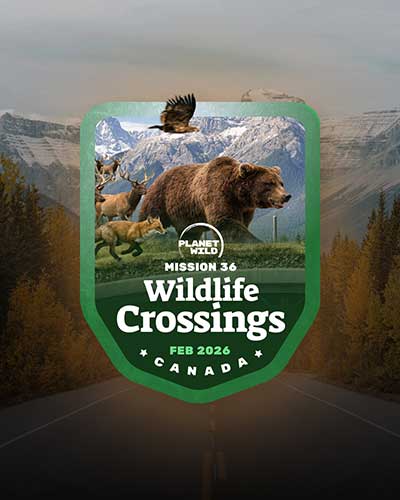
For centuries, animals moved freely across the Rocky Mountains, the largest mountain range in North America. Grizzly bears once ranged from the Arctic Circle all the way south to Mexico, moving through habitats that supported their needs and connected distant populations.
But the modern world has changed the map.
Highways, railways, towns and other human developments have divided once-connected wilderness into smaller, isolated patches. Grizzly bear populations have lost much of their historical range, while many other animals face barriers that prevent them from reaching new habitats, finding mates or moving away from environmental threats.
Isolation has consequences. When wildlife populations become separated, their gene pools can shrink, leaving them more vulnerable to disease and environmental change. Animals also face immediate dangers as they try to cross busy roads and railways.
The scale of the problem is staggering. In the United States alone, at least two million wildlife-vehicle collisions occur every year, causing countless animal deaths and an estimated US$8 billion in damage and emergency costs. The challenge is clear: how can we reconnect the natural world without dismantling the roads and infrastructure that people depend on?
The Mission: Helping Wildlife Cross Safely
The Planet Wild community has joined forces with Yellowstone to Yukon Conservation Initiative (Y2Y) to help reconnect one of the most important wildlife landscapes in North America: the Yellowstone to Yukon region.
The vision is to create a vast, connected network of habitats stretching from Yellowstone in the United States to the Yukon in Canada. This landscape encompasses more than 100 protected areas, but wildlife needs more than protected land. It also needs safe ways to move between those areas.
The solution is not necessarily to remove roads. Instead, conservation teams are finding ways to redesign them so that animals can cross safely.
Wildlife crossings come in several forms. Some are impressive overpasses built above highways, covered with soil, grasses, shrubs and trees to create a natural-looking route across the road. Others are underpasses that allow larger animals to travel beneath traffic. There are even tunnels designed for smaller creatures, including toads and salamanders.
Fencing can guide animals towards these crossings, helping prevent them from wandering onto busy roads. Where properly designed and implemented, wildlife crossings can reduce animal-vehicle collisions by more than 90%.
More than 200 crossings have already been built across the wider region, helping wildlife move through a landscape that would otherwise be divided by human infrastructure.
Yet important gaps remain.
Along Highway 3 in Alberta, Canada, a major barrier interrupts wildlife movement in both north–south and east–west directions. The highway separates two grizzly bear populations, making it harder for the animals to move between habitats and maintain connections between their populations.
Building effective crossings here requires careful planning. It is not enough to choose a convenient location and construct a bridge or tunnel. Conservation teams need to understand where animals actually travel, which species use particular routes and where a new crossing would make the greatest difference.
That is where technology and data become essential.
With support from the Planet Wild community, the project is funding six trail cameras and 15 GPS wildlife collars to help guide conservation planning along Highway 3.
The trail cameras record animal movements and help researchers assess how wildlife uses existing crossings. GPS collars provide detailed information about where animals travel, revealing important movement routes and identifying locations where additional crossings may be needed.
This evidence can make a real difference. Major infrastructure projects require extensive planning, government approvals and significant public investment. Reliable data helps demonstrate where crossings are needed, which animals would benefit and how proposed structures could improve connectivity.
In other words, these cameras and collars do more than track wildlife. They help build the case for the changes needed to protect it.
The long-term vision is a landscape where highways and towns no longer function as insurmountable barriers, where grizzly bears and other wildlife can move more safely between habitats, and where isolated populations have a better chance of remaining connected.
We cannot turn back the clock to a time before roads divided the wilderness. But we can make thoughtful changes that allow nature to move through the modern world.
Sometimes, reconnecting a landscape begins with a bridge over a highway, a tunnel beneath the road, or a small camera quietly recording an animal's journey. Together, these efforts can help make a much larger vision possible: a North America where wildlife has room to roam again.
Planet Wild Total invested: €50,000
Immediate impact:
- Trail cameras installed to prove crossing efficacy
- GPS collars deployed to map new crossing hotspots
Ideal outcome:
- Reconnecting isolated grizzly populations at Highway 3
- 1.3 million km2 of interconnected habitat restored
- Reduction in wildlife-vehicle collisions
Update Videos:
Impact Update Year One
Scheduled for 2027