
Some of nature’s most important work happens quietly, beneath our feet.
For thousands of years, Europe’s peatlands have helped regulate water, support wildlife and store enormous amounts of carbon. These remarkable wetlands develop in waterlogged conditions where there is too little oxygen for dead plant material to decompose fully. Instead, layer upon layer of vegetation accumulates over centuries, gradually forming peat. The result is one of nature’s most effective carbon storage systems. Although peatlands cover only around 3% of the world’s land surface, they store more carbon than all the world’s forests combined. But this ancient process is remarkably easy to disrupt.
Over the past century, more than 80% of Europe’s wetlands have been drained to make land more suitable for agriculture. Networks of straight drainage ditches channel water away, drying out landscapes that evolved to remain wet. In Belgium’s Black Creek Valley, more than 1,000 km of drainage ditches were dug, drying out peat that had taken thousands of years to form. Once exposed to oxygen, the peat begins to decompose, releasing carbon that had been stored underground for centuries. In a relatively short period of human history, an ecosystem that quietly protected the climate and supported biodiversity was transformed into something very different.
The Mission: Bringing Ancient Wetlands Back to Life
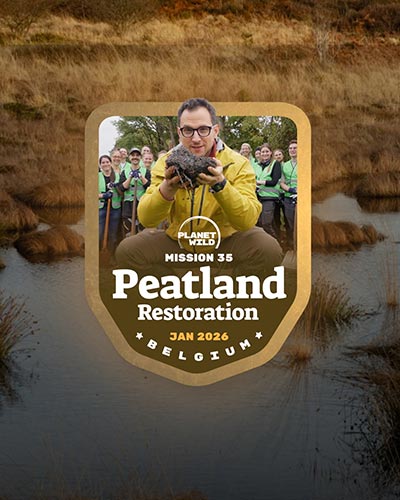
Together with conservation partners EcoTree and Natuurpunt, the Planet Wild community set out to restore the peatlands of Belgium’s Black Creek Valley.
This mission was particularly special because, for the first time, members of the Planet Wild community were invited into the field to take part in the restoration work themselves. Instead of simply supporting the project from afar, participants could get their hands dirty and help return the landscape to its natural state.
The central task was deceptively simple: fill in the drainage ditches and allow the water to remain in the wetland.
By blocking the channels that had been carrying water away, the team could begin restoring the waterlogged conditions peatlands need to survive. As the soil becomes saturated again, oxygen is limited, decomposition slows, and carbon can remain stored in the peat rather than escaping into the atmosphere.
But restoring a wetland takes more than holding back water.
The project also funded the removal of non-native trees, invasive young saplings and fast-growing grasses that were disrupting the natural habitat. These activities, together with five years of monitoring, will help the conservation team track the wetland’s recovery and understand how the ecosystem responds over time.
With the support of the Planet Wild community, seven hectares of peatland have been restored - and nature is already showing signs of returning.
Water clover is beginning to sprout. Beavers have returned to build dams, further influencing how water moves through the landscape. And cranes have come back to nest, offering a wonderful sign that the recovering wetland is once again providing habitat for wildlife.
These changes are about far more than creating a beautiful place to visit. Healthy peatlands help regulate water, support diverse communities of plants and animals, and keep vast stores of carbon safely underground. Their restoration can benefit the wider landscape long after the initial work is complete.
There is something hopeful about this kind of conservation. We often think of protecting nature as defending what remains, but sometimes it also means undoing the damage we have caused - reopening waterways, restoring natural conditions and allowing an ecosystem to find its way back.
Seven hectares may seem small beside the scale of wetland loss across Europe. Yet every restored patch matters, particularly when it begins to support the return of plants and animals that depend on these habitats.
Thousands of years of peat formation cannot be replaced overnight. But by bringing water back, giving nature space to recover and continuing to monitor the results, we can help ensure that these extraordinary wetlands continue doing their quiet, essential work for generations to come.
Planet Wild Total invested: €220,000
Immediate impact:
- Peatland restoration on 7.5 Hectares of degraded farmland
- Stopped decay of deeper peat layers
Ideal outcome:
- Regeneration of rare European peatland ecosystems
- Return of rare species like cranes, beavers, and wolves
- Long-term carbon storage secured
Update Videos:
Impact Update Year One
Scheduled for 2027